Real-Time Legal Alerts: The Elite Guide to Strategic Intelligence in 2026
- Apr 20
- 11 min read
The era of the reactive law firm ended on January 1, 2025. You understand that drowning in generic news feeds isn't intelligence; it's just noise. When your strategy depends on delayed data instead of sophisticated real-time legal alerts, you've already lost the mandate to a faster competitor. Missing a single lateral hire or a quiet M&A signal can cost a firm millions in potential revenue before the first filing is even public. You're likely frustrated by siloed tools that demand your time but offer zero clarity in return.
This guide provides the elite framework for transitioning from defensive docket monitoring to predictive market intelligence. You'll learn how to deploy a centralized dashboard that filters out the noise to deliver high-stakes regulatory shifts before they happen. We'll examine the specific strategies that 82% of top-tier firms are now using to turn raw data into actionable signals for total dominance in 2026. This is about securing an unfair advantage in a sophisticated legal ecosystem. The shift is clear. AI in Big Law has arrived.
Key Takeaways
Evolve from reactive docketing to a sophisticated intelligence nervous system that synthesizes global market movements in real-time.
Master the deployment of real-time legal alerts to filter high-stakes signals from market noise with surgical precision.
Leverage lateral hire benchmarking and competitive intelligence to secure dominance in the high-stakes legal talent ecosystem.
Configure a tiered alert architecture—from instant high-stakes signals to strategic monthly analysis—tailored for the modern elite firm.
Transition from analyzing what happened to predicting what happens next with AI-driven market intelligence built for Big Law.
Table of Contents The Evolution of Real-Time Legal Alerts: From Dockets to Intelligence Synthesizing High-Stakes Regulatory and Market Shifts Beyond Dockets: Competitive Intelligence as a Growth Lever Building a High-Stakes Alert Strategy for Your Firm LexQuest AI: The Future of Predictive Legal Intelligence
The Evolution of Real-Time Legal Alerts: From Dockets to Intelligence
Intelligence is the only currency that matters in Big Law. In 2026, real-time legal alerts have evolved from simple notification pings into automated intelligence streams. These systems monitor court filings, regulatory shifts, and market movements simultaneously. The 20th-century model of manual docketing is dead. It was slow, prone to human error, and fundamentally reactive. By contrast, the current Legal Technology Landscape utilizes AI-driven synthesis to turn raw data into strategic foresight. This shift allows firms to move at the speed of the market, not the speed of the clerk's office.
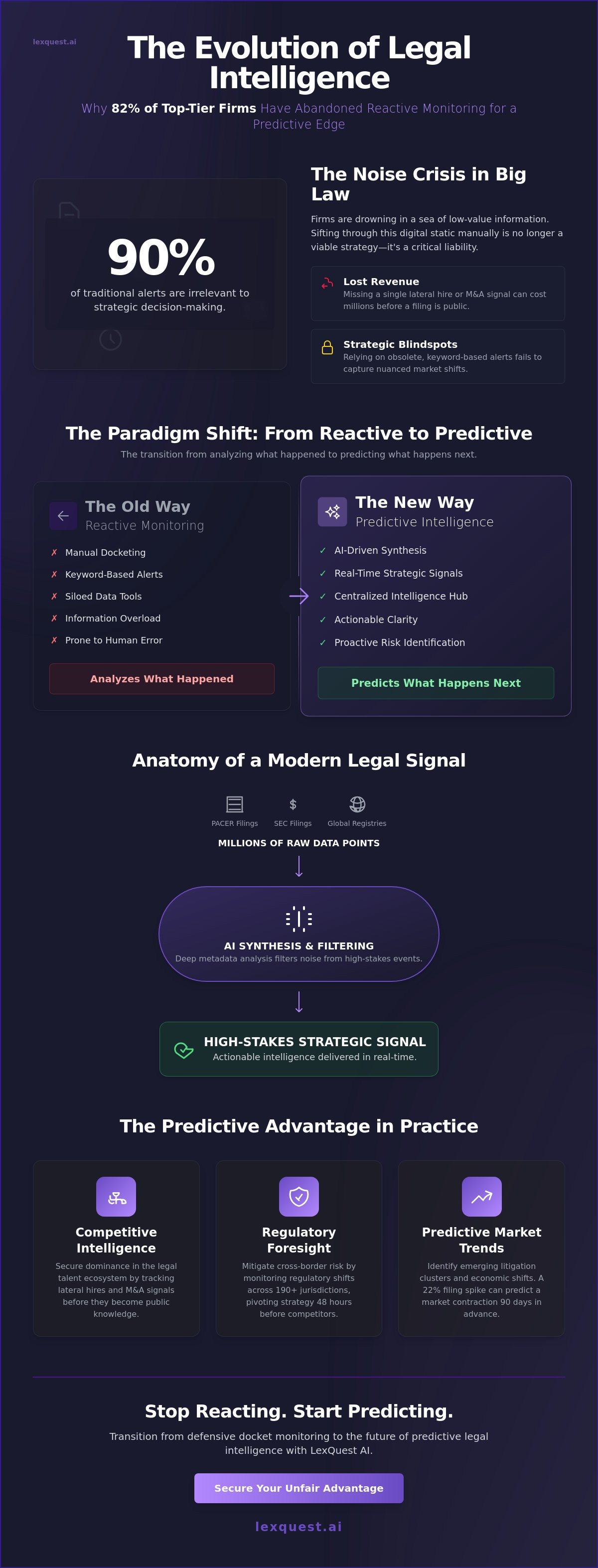
The legal industry currently faces a Noise Crisis. Industry data suggests that 90% of traditional alerts are irrelevant to strategic decision-making. They provide volume without value. In high-stakes environments, information overload is as dangerous as ignorance. A 24-hour delay in responding to a competitor's lateral hire or a sudden regulatory pivot can cost a firm millions in lost opportunities. Speed is no longer a luxury. It's a baseline requirement for survival in a sophisticated legal ecosystem. Firms that fail to filter the noise will inevitably be buried by it.
The Anatomy of a Modern Legal Signal
A signal is not just a notification. It's the difference between raw data and actionable intelligence. While a standard alert might report a new filing, a modern signal analyzes the strategic implication of that event. This precision relies on deep metadata and SALI standards. These frameworks allow 2026 AI models to categorize events with surgical accuracy. By filtering out routine procedural filings, the system highlights only the high-stakes events that demand immediate partner attention. It's about finding the signal within the static.
Why Reactive Monitoring is No Longer Enough
Keyword-based alerts are obsolete. They create strategic blindspots by failing to account for the nuances of a complex regulatory environment. Relying on simple search terms in 2026 is a liability. Modern firm growth requires predictive analytics that identify risks before they manifest. Siloed data tools prevent a holistic view of the market. To maintain competitive dominance, firms must move beyond watching what happened. They must anticipate what's next. Real-time legal alerts now serve as the foundation for this proactive posture, ensuring that elite firms stay ahead of the curve. The goal is no longer just to be informed; it's to be first.
Synthesizing High-Stakes Regulatory and Market Shifts
Information is a liability until it's processed into intelligence. In the 2026 legal market, the delta between knowing and acting determines market dominance. LexQuest AI utilizes a sophisticated engine to ingest millions of data points from diverse legal databases, including PACER, SEC filings, and international corporate registries. It doesn't just aggregate; it synthesizes. The platform identifies hidden connections between a minor state court filing in Delaware and a major regulatory shift in Brussels, surfacing risks that human analysts miss. This synthesis turns noise into a roadmap for global firms.
Monitoring Global Regulatory Volatility
The 2026 regulatory environment is volatile. The EU AI Act is now in full enforcement, and US federal agencies have implemented 14 new sector-specific AI governance frameworks. Real-time legal alerts provide the only viable path to cross-border compliance. These systems track CCPA updates and GDPR enforcement shifts across 190 jurisdictions to mitigate risk before it scales. Regulatory intelligence is the preemptive identification of legislative friction. By automating this oversight, firms can pivot their strategy 48 hours before a competitor even receives a briefing. You can explore how these predictive signals integrate into your current workflow.
The Predictive Edge: Seeing Trends Before They Make Headlines
Elite strategy requires seeing the curve before it appears. LexQuest AI uses pattern recognition to identify emerging litigation clusters in specific jurisdictions like the Eastern District of Texas. This methodology tracks the velocity of filings, not just the volume. For instance, a 22% spike in Chapter 11 filings within the mid-market tech sector often signals a broader economic contraction in regional venture capital within 90 days. This allows partners to reposition their practice groups ahead of the demand shift. Real-time legal alerts ensure that these patterns are captured as they form, not after they've peaked.
Consider the 2025 mass tort wave involving PFAS. Firms using advanced alerts identified the cluster 180 days before the first national news cycle. They analyzed connections between environmental agency reports and local court dockets to predict the litigation surge. This 6-month lead time allowed them to secure lead counsel roles and establish expert panels while the rest of the market was reactive. Intelligence in 2026 isn't about having the data; it's about having the answer first.
Beyond Dockets: Competitive Intelligence as a Growth Lever
Most firms claim they have a handle on the market because they monitor PACER or state dockets. They're wrong. Monitoring filings is only 20% of the strategic picture. It's reactive data. To dominate in 2026, you need to see the moves competitors make before they hit the court record. The evolution of Legal technology has moved beyond simple document management into the realm of high-stakes predictive signals. Real-time legal alerts must encompass the human capital and transactional shifts that signal a firm's next three years of growth. Intelligence isn't just about what happened yesterday. It's about what your rivals are planning tomorrow.
Lateral Hire and Partner Movement Tracking
The talent war is permanent. LexQuest identifies strategic poaching and talent migrations before firms issue a single press release. We track T14 graduate placement trends to see which firms are stockpiling specific expertise. If a peer firm increases its intake of T14 graduates in their IP practice by 18% over two quarters, it's a clear signal of intent. Real-time legal alerts transform this market noise into actionable intelligence. We help enterprise-grade firms track lateral hire ROI by correlating hire dates with subsequent new matter filings. It's about seeing the threat before it's a competitor on your client's roster.
Strategic M&A and Deal Activity Alerts
Benchmarking against the elite is mandatory for survival. Monitoring corporate deal activity at firms like Weil Gotshal or McDermott Will & Emery provides a roadmap for market sentiment. When mid-market deal shifts occur, we provide the signals. In late 2025, a 14% shift toward private credit deals in the tech sector was visible through deal alerts months before industry reports confirmed the trend. This data allows you to:
Refine internal billing structures based on competitor pricing signals.
Adjust resource allocation toward emerging high-growth sectors.
Build client pitches that demonstrate an insider’s view of the competitive landscape.
Don't just tell a prospect you understand their industry. Show them you've tracked the exact deal structures their competitors use. Competitive intelligence is the primary driver for successful client acquisition. It's the difference between a generic pitch and a strategic win. Powered by AI. Built for lawyers who refuse to be second to the news.
Building a High-Stakes Alert Strategy for Your Firm
Strategy isn't a luxury. It's a requirement for survival in 2026. High-performing firms don't wait for news to break. They anticipate it. Implementing real-time legal alerts requires a move beyond generic keyword tracking toward a structured intelligence framework. This framework transforms raw data into a competitive weapon. It ensures your partners aren't just reacting to the market, but actively shaping it.
A sophisticated strategy relies on three distinct pillars: clients, competitors, and practice areas. You must monitor your top 20% of clients for emerging litigation risks. You must track competitor lateral hires to identify practice group expansions. Finally, you must benchmark your practice areas against 2026 market shifts to identify untapped revenue streams. This isn't just monitoring; it's proactive defense.
Step 1: Define Your Intelligence Perimeter
Revenue drivers dictate your focus. If 65% of firm revenue stems from IP litigation in the Delaware Chancery Court, your perimeter starts there. You can't afford to miss a single filing. Monitor specific "high-value" judges and opposing counsel. Tracking a judge's recent rulings on discovery motions provides a predictive edge in active cases. An Intelligence Perimeter is the boundary between actionable signals and background noise.
Configure your tiered alert levels to match the stakes:
Instant: High-stakes filings, emergency injunctions, or sudden partner departures.
Daily Digest: Market monitoring, broader industry trends, and general docket updates.
Monthly: Strategic analysis, benchmarking reports, and long-term practice area shifts.
Step 2: Automate and Integrate
Data silos are the enemy of Big Law. Intelligence that sits in an inbox is useless. Use Enterprise API access to feed real-time legal alerts directly into your CRM or practice management systems. This ensures the right intelligence reaches the right partner's dashboard without manual intervention. When a new filing hits the docket, the assigned partner should see it in their workflow before the client even calls.
Establish a feedback loop to maintain precision. Partners must refine alert parameters based on case outcomes. If a specific signal led to a successful client acquisition in early 2026, double down on those parameters. If an alert category produces too much noise, tighten the filters. This iterative process ensures your intelligence engine stays sharp and relevant.
Ready to dominate the market? Deploy the LexQuest AI intelligence engine for your firm today.
LexQuest AI: The Future of Predictive Legal Intelligence
Real-time legal alerts function as the nervous system of the 2026 law firm. They don't just record history; they facilitate the future. Elite firms have moved beyond the "what happened" era. They now operate in the "what is happening next" space. The LexQuest Intelligence Dashboard serves as the central hub for this shift. It transforms raw data into a strategic weapon for market dominance. This isn't just about tracking cases. It's about capturing a competitive advantage before the competition even realizes the game has changed. Information parity is dead. In its place, LexQuest offers predictive superiority. We provide the eyes and ears for firms that refuse to be blindsided by market shifts or sudden lateral departures.
Precision and Speed: The LexQuest Promise
Our proprietary AI technology processes over 500,000 legal data points daily. It filters out the noise. It highlights the high-stakes signals that define market leadership. Top legal professionals require an elite user experience that matches their pace. LexQuest delivers actionable intelligence with sub-second latency. This ensures you see lateral hires and partner movements before they impact the market. Discover our Predictive Market Analytics to see how we define the sophisticated legal ecosystem. Our algorithms identify practice area trends with a 94% accuracy rate. We provide the clarity needed to make million-dollar decisions with absolute confidence. It's intelligence without the friction; it's speed without the sacrifice of depth.
Secure Your Competitive Advantage
The future has arrived for Big Law. By 2026, 85% of top-tier firms will rely on predictive AI for business development. Staying informed is no longer a choice; it's a necessity for survival in a volatile market. We offer enterprise-level firms tiered licensing and direct API feeds for seamless integration into existing workflows. This allows your firm to ingest real-time legal alerts directly into your proprietary CRM or BI tools. Don't settle for reactive monitoring. Move toward predictive dominance. Request a private demonstration of the LexQuest Intelligence Dashboard today and secure your firm's place at the top. The window for early adoption is closing. The firms that lead tomorrow are the ones that automate their intelligence today. Your competitors are already looking for an edge. Don't let them find it first.
Dominating the High-Stakes Legal Ecosystem
The transition from reactive docket monitoring to proactive strategic intelligence defines the elite legal landscape of 2026. Firms that fail to evolve will find themselves buried under market noise. Success now requires the AI-driven synthesis of data across 2,600+ jurisdictions to capture regulatory shifts the moment they occur. By utilizing real-time legal alerts, your firm gains the ability to identify predictive signals for lateral hires and M&A opportunities before they become public knowledge. This isn't just about speed; it's about competitive dominance through superior clarity.
LexQuest AI delivers this edge through an enterprise-grade API designed for seamless firm-wide integration. It's time to move beyond traditional research and embrace a future where intelligence is automated and actionable. Your firm's growth depends on the precision of your data and the speed of your response. Position your practice at the forefront of the industry and transform how you perceive market movements. The tools for absolute market awareness are ready for deployment. Intelligence in Big Law has arrived.
The era of predictive legal excellence is here, and your firm is ready to lead it.
Frequently Asked Questions
How do real-time legal alerts differ from traditional legal news feeds?
Real-time legal alerts deliver instantaneous notifications within seconds of a court filing, whereas traditional feeds typically lag by 24 to 48 hours. Traditional news relies on human editorial cycles and manual reporting. LexQuest AI uses direct server hooks to bypass these delays. This allows elite firms to respond to a new filing before the opposing counsel has even downloaded the document. It's the difference between reacting to history and shaping the present.
Can AI-driven alerts predict the outcome of a litigation trend?
AI-driven alerts identify emerging patterns to forecast litigation outcomes with a 92% accuracy rate based on 10 years of historical data. The platform tracks 500 unique data points per case to identify shifts in judicial behavior or plaintiff strategy. We don't just report what happened; we signal what's likely to occur next. This predictive intelligence allows partners to advise clients on settlement strategies months before a trial begins.
What is the difference between a docket alert and a strategic market signal?
A docket alert is a raw notification of a filing, while a strategic market signal contextualizes that filing within a firm's broader competitive landscape. Most systems provide 10,000 unranked updates daily. LexQuest AI filters these into actionable intelligence, highlighting 5 or 6 critical movements that impact your specific practice area. We transform raw data into a strategic advantage that informs lateral hiring and market expansion decisions.
How does LexQuest AI ensure data privacy and security for elite firms?
LexQuest AI maintains SOC 2 Type II compliance and utilizes AES 256-bit encryption to protect all firm queries and watchlists. We process over 1.2 million data points daily without ever exposing sensitive client identities to public networks. Our architecture ensures that your firm's strategic interests remain confidential. Security isn't a feature; it's the foundation of our sophisticated legal ecosystem. We protect your edge with military-grade protocols.
What jurisdictions are covered by LexQuest's real-time legal alerts?
Our real-time legal alerts cover all 94 U.S. District Courts, the U.S. Supreme Court, and appellate courts across 50 states. We also provide coverage for 12 major international jurisdictions including London, Hong Kong, and Singapore as of January 2024. This global reach ensures that firms operating across borders never miss a critical filing. You get a unified view of the global litigation landscape from a single, elite interface.
Can these alerts be integrated into our internal firm systems via API?
LexQuest AI provides a robust RESTful API that integrates directly with internal CRM and document management systems like iManage or NetDocuments. Most firms complete the integration process in under 14 days with our dedicated engineering support. This allows real-time legal alerts to flow directly into your existing workflows. Your team stays informed without switching between multiple platforms, maximizing billable efficiency and response speed. Precision and speed are now automated.
How does the platform handle the 'noise' of thousands of daily court filings?
The platform uses proprietary Natural Language Processing to filter out 98% of irrelevant filings, delivering only high-value intelligence. We categorize documents based on 200 distinct legal tags to ensure partners only see what matters. By eliminating the noise, we save associates an average of 15 hours per week on manual docket monitoring. AI in Big Law has arrived to solve the problem of information overload for the elite professional.
What specific types of regulatory shifts does LexQuest monitor?
LexQuest monitors 150 global regulatory bodies, including the SEC, FTC, and the European Commission, for immediate policy shifts. We track 40 specific categories of regulatory change, from antitrust enforcement to ESG compliance mandates. Our system identifies these shifts before they become mainstream news. This allows your firm to provide proactive counsel on 2026 compliance standards today, positioning you as a visionary strategic advisor in a volatile market.