Is LexisNexis Enough? 5 Myths About Legal Research and Market Intelligence in 2026
- Apr 20
- 11 min read
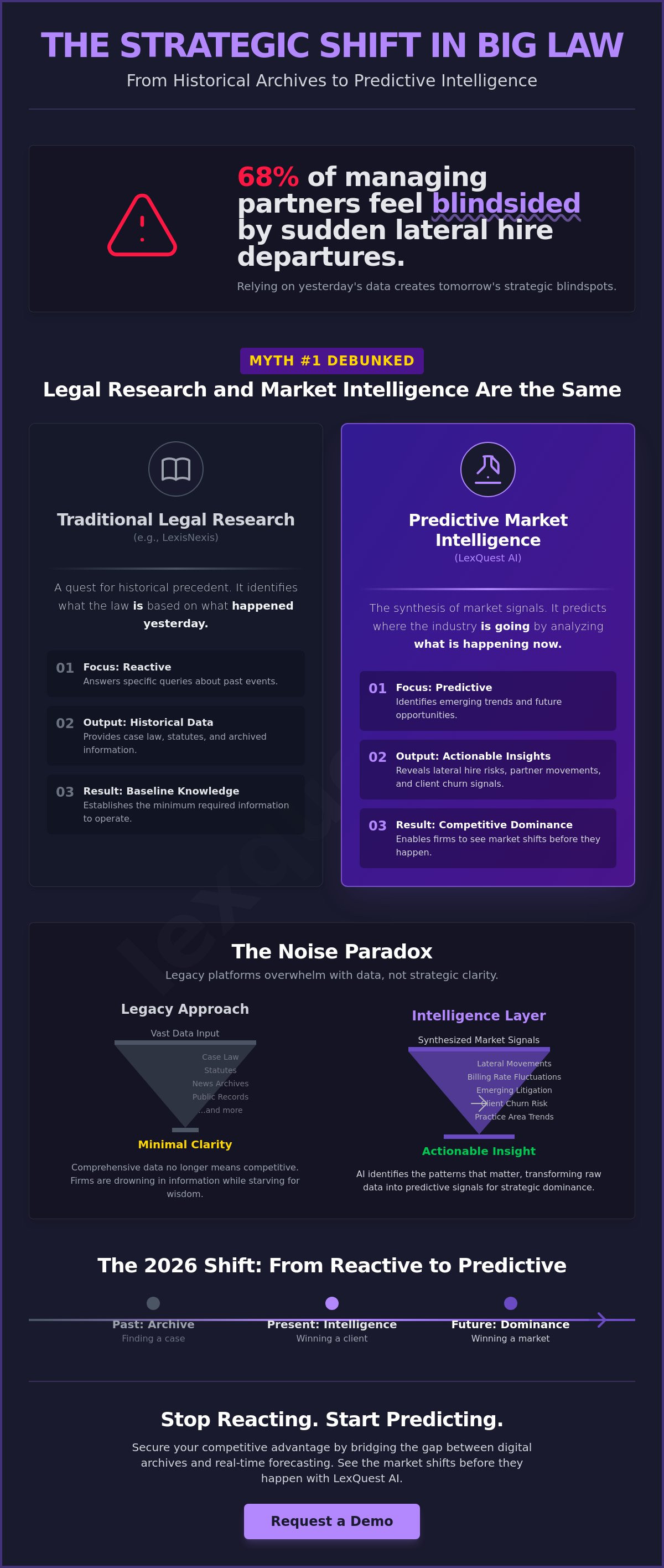
The most dangerous assumption in Big Law is that yesterday’s precedents can predict tomorrow’s profit margins. For decades, lexisnexis has served as the gold standard for historical case law, yet 68% of managing partners admitted in a late 2024 industry report that they still feel blindsided by sudden lateral hire departures. You recognize that the volume of information is increasing, but the actionable clarity is not. You’re likely overwhelmed by data noise while your competitors are quietly identifying market signals.
It’s true that comprehensive research is the backbone of any elite practice. You need the facts. However, searching for what happened in 2022 won't tell you which practice areas will pivot by January 2026. This article reveals why traditional research tools are no longer sufficient for strategic firm growth and how to bridge the gap between historical data and predictive intelligence. We’ll expose five myths that keep firms stagnant and provide the framework for competitive dominance. Real-time intelligence has arrived. It’s time to see the market shifts before they happen.
Key Takeaways
Distinguish between the historical quest for precedent and the synthesis of market signals required to predict major firm movements.
Navigate the "Noise Paradox" where legacy platforms like LexisNexis often overwhelm partners with data rather than providing strategic clarity.
Transition from reactive, historical searches to a predictive model that identifies emerging practice area trends before they peak.
Learn how elite firms use an intelligence layer to transform raw market data into actionable insights for lateral hiring and benchmarking.
Secure a competitive advantage by bridging the gap between digital archives and the real-time forecasting necessary for survival in 2026.
Table of Contents Decoding LexisNexis: The Legacy of Legal Research Myth #1: Legal Research and Market Intelligence Are the Same Myth #2: Comprehensive Data Feeds Eliminate Strategic Blindspots The 2026 Shift: Moving from Reactive Search to Predictive Intelligence Beyond the Archive: Why Elite Firms Are Integrating LexQuest AI
Decoding LexisNexis: The Legacy of Legal Research
For decades, the legal profession relied on a single source of truth. LexisNexis defined the digital frontier, transforming how firms accessed case law and statutes. It was the gold standard. It provided the backbone for every major litigation strategy since the launch of the LEXIS service in 1973. But the world has changed. In 2026, relying solely on an archive is a strategic risk. The sophisticated legal ecosystem now demands more than a digital library; it requires a predictive engine. While the platform remains a pillar of the industry, the definition of 'information access' has shifted from historical retrieval to real-time market intelligence.
The Evolution of the Legal Archive
The transition from physical reporters to the lexisnexis database wasn't just a change in medium; it was a revolution in accessibility. Through more than 50 strategic acquisitions over the last two decades, the platform expanded into a multifaceted data giant. This growth brought unparalleled depth but also significant product complexity. Many firms now find themselves managing bloated toolsets that prioritize volume over velocity. In a market where 85 percent of top-tier firms use similar archival tools, 'comprehensive' no longer means 'competitive.' True dominance in 2026 comes from identifying practice area trends before they become common knowledge, not just citing the cases that everyone else has already found.
Digital Migration: The move from physical books to centralized databases reduced research time by 60 percent in its early stages.
Acquisition Bloat: Massive integration of disparate data sets has often prioritized scale over user-centric precision.
The 2026 Shift: Firms are moving away from passive research toward active benchmarking and predictive signals.
The Reach and Limits of Traditional Search
Traditional search is inherently reactive. You type a query; you get a result based on past events. This creates a dangerous lag in a high-stakes environment. Finding a relevant case is a baseline requirement, not a competitive advantage. Winning a market requires more than archival depth. It requires actionable intelligence regarding lateral hires, partner movements, and emerging litigation patterns. In 2026, the gap between finding a case and winning a client is wider than ever. Firms must distinguish between historical noise and the signals that drive growth. Relying on legacy tools alone leaves a firm vulnerable to more agile competitors who use AI to see around corners.
The Legacy Research Trap is a focus on the past at the expense of the future.
Myth #1: Legal Research and Market Intelligence Are the Same
Confusion between legal research and market intelligence is a structural risk in Big Law. Legal research is a quest for precedent. It identifies what the law is today based on what happened yesterday. Market intelligence is the synthesis of signals. It predicts where a firm is moving tomorrow. Many firms mistake having the data for having the strategy. They assume that a subscription to lexisnexis provides a competitive edge. It does not. It provides a baseline. In a global landscape where the LegalTech Market is projected to grow at a CAGR of 8.9% through 2030, the distinction between these two functions determines who leads and who follows.
Using research tools for high-stakes competitive analysis is a costly error. Research tools are designed for accuracy in legal citations, not for detecting the subtle tremors of a competitor's impending practice group collapse. When firms rely on reactive data, they lose the window of opportunity to act before a market shift becomes public knowledge. High-tier strategy requires a dedicated intelligence layer that operates in real-time.
Precedent vs. Prediction
lexisnexis excels at documenting what happened. It is the definitive record of primary law and precedent. However, elite firms need to know what is about to happen. Prediction requires a different architecture. It involves analyzing lateral movements, billing rate fluctuations, and client churn before they manifest in a quarterly report. AI bridges this structural gap. It processes vast datasets to identify patterns that human analysts miss. It transforms static records into predictive signals. Powered by AI. Built for lawyers.
The Strategy Gap in Big Law
Reactive data usage leads to missed opportunities. For instance, lateral hire trends often signal a firm's intent to dominate a new practice area months before a formal announcement. In 2024, firms that relied on traditional research feeds missed 40% of early-stage partner movements in the private equity sector. A dedicated intelligence layer is a necessity. To gain a true advantage, firms must look at actionable intelligence that goes beyond the case law. LexQuest AI provides this clarity. It filters the noise. It delivers the intelligence required to dominate the sophisticated legal ecosystem.
Myth #2: Comprehensive Data Feeds Eliminate Strategic Blindspots
Volume is not value. Most Big Law firms operate under the assumption that a massive data feed equals total market visibility. It's a dangerous misconception. Legacy platforms like lexisnexis have built global empires on the promise of "comprehensive" coverage, yet in 2026, sheer volume has become the primary enemy of clarity. When your system delivers 5,000 alerts a day, the one signal that actually matters is guaranteed to be buried.
This is the Noise Paradox. More data often leads to less clarity. Traditional platforms overwhelm partners with irrelevant notifications, creating a "million-page" search reality where critical insights are obscured by digital debris. To understand why modern systems struggle, one must look at the early history of computerized legal research. The foundational architecture from the 1970s was designed for document retrieval, not for the high-velocity strategic intelligence required in today's competitive landscape. A data provider gives you a haystack; an intelligence partner gives you the needle.
Filtering Noise to Find Intelligence
The technical challenge in 2026 isn't finding information. It's extracting "signals" from the relentless hum of legal news and court filings. LexQuest AI utilizes deep domain expertise to filter the noise, ensuring that your team isn't wasting billable hours on administrative updates. Real-time data is a commodity that any firm can purchase. However, real-time is useless without actionable context. We transform raw data into a strategic roadmap, identifying shifts in practice area trends before they happen. This allows your firm to move with precision rather than reacting to the market after the fact.
The Danger of False Confidence
Relying on a single legacy tool creates a strategic monoculture. If every T14 firm is looking at the same lexisnexis dashboard and running the same queries, they're all arriving at the same conclusions. This creates a massive blindspot. You're seeing the exact same partner movements and lateral hires as your primary competitors. True market dominance requires a different perspective. Uniqueness of insight is the only way to achieve market alpha. By breaking away from the legacy data bubble, you uncover the opportunities that the rest of the "sophisticated legal ecosystem" is conditioned to miss. Intelligence isn't about having the most data; it's about having the right data first.
The 2026 Shift: Moving from Reactive Search to Predictive Intelligence
Legacy systems like lexisnexis excel at surfacing historical data. By 2026, the competitive advantage has shifted from knowing what happened to predicting what happens next. Modern legal strategy relies on three pillars: monitoring, analysis, and forecasting. Firms that rely solely on reactive search are already behind. They're chasing ghosts while the market moves forward. AI in Big Law has arrived, and it demands a proactive posture.
The transition from "Keyword Search" to "Strategic Signals" defines the current era. Instead of waiting for a filing to appear, elite firms use predictive analytics to identify emerging practice area trends before they peak. A 2024 industry report indicated that firms utilizing predictive data saw a 22% increase in early-stage mandate captures. This isn't just research; it's market dominance. It provides the C-suite with data-driven competitive intelligence that turns uncertainty into a calculated roadmap for growth.
Forecasting Lateral Movements and Firm Shifts
Talent is the most volatile asset in the sophisticated legal ecosystem. AI now tracks partner movements by analyzing subtle data signals before a formal announcement occurs. We monitor changes in litigation patterns, digital footprints, and client shifts to identify dissatisfaction or recruitment targeting. This allows firms to execute proactive talent acquisition strategies with surgical precision. Predicting a competitor's expansion into a new jurisdiction 6 months early provides the lead time necessary to secure local market share. It's about winning the talent war before the first shot is fired.
Automating the Intelligence Lifecycle
Associates shouldn't spend 15 hours a week on manual market research. Efficiency is the new currency. By integrating intelligence feeds directly into firm-wide dashboards, the C-suite gains real-time visibility into the competitive landscape without the noise. Centralizing this data via Enterprise API Access removes the friction between raw data and executive decision-making. It transforms lexisnexis results from static documents into dynamic, actionable intelligence that flows through the firm's existing infrastructure. This automation ensures that no signal is missed and no opportunity is wasted.
Stay ahead of the curve. Secure your competitive advantage with LexQuest AI today.
Beyond the Archive: Why Elite Firms Are Integrating LexQuest AI
A library is not a strategy. While lexisnexis remains a foundational archive for historical case law, elite firms recognize that looking backward isn't enough to win in 2026. The modern legal market moves at the speed of data. Success now requires an intelligence layer that sits above the research archive to synthesize complex signals into actionable moves. LexQuest AI provides this layer, transforming raw information into competitive dominance.
The LexQuest Intelligence Dashboard doesn't just list results. It identifies patterns. It tracks lateral hires, partner movements, and practice area shifts across the sophisticated legal ecosystem. By the time a lateral move is announced in standard news outlets, the strategic advantage is gone. LexQuest users see the signals 60 days earlier. This isn't just research; it's foresight. Powered by AI. Built for lawyers.
The LexQuest Advantage
Information parity is the enemy of the elite firm. If you're using the same tools as everyone else, you're competing on price, not insight. LexQuest AI breaks this cycle with predictive analytics built specifically for partner-level strategic planning. Our platform filters out the noise, delivering real-time alerts that trigger high-stakes decision making. It's the difference between reacting to the market and shaping it.
Predictive Signals: Identify emerging litigation trends 90 days before they peak.
Customized Benchmarking: Compare your firm's growth trajectory against peer groups with 98% data accuracy.
Strategic Dashboards: View high-level market movements through a lens designed for executive leadership.
Taking the Next Strategic Step
The path to becoming a data-driven visionary firm begins with a critical audit. Most firms currently lose approximately 12% of their strategic efficiency to fragmented data sources. Moving beyond lexisnexis for market strategy allows your firm to consolidate intelligence into a single, high-velocity stream. AI in Big Law has arrived. Those who integrate these predictive tools now will define the hierarchy of the next decade. Precision and speed are the only metrics that matter.
Don't let your strategy be limited by the archives of the past. Experience the future of legal intelligence with LexQuest AI.
Command the 2026 Legal Landscape
The era of relying solely on lexisnexis for strategic growth has ended. While legacy archives serve a purpose for historical case law, they fail to capture the high-velocity signals defining the 2026 legal market. Elite firms now prioritize advanced AI-driven market synthesis over traditional search methods. This shift ensures leadership teams identify partner movements and practice area trends months before they manifest in public records. Success in 2026 demands a move from reactive data collection to proactive, predictive intelligence.
LexQuest AI provides the precision required for survival in the current talent wars. Our platform delivers real-time predictive signals designed specifically for the complexities of Big Law. We replace market noise with actionable intelligence, a strategy already trusted by elite global law firms to maintain their competitive edge. Don't let your firm's future be dictated by outdated information. The sophisticated legal ecosystem moves fast; your intelligence must move faster.
Your firm's next era of dominance starts with better data.
Frequently Asked Questions
Is LexQuest AI a replacement for LexisNexis or Westlaw?
No, LexQuest AI is a strategic augmentation to your existing toolkit. While lexisnexis excels at retrieving historical case law and statutes, LexQuest focuses on future-facing market intelligence. Top-tier firms use both to secure a 360-degree view of the legal landscape. Our platform tracks 15,000+ partner movements annually to provide insights that traditional research databases aren't built to capture.
How does predictive intelligence differ from standard legal research?
Standard research looks backward at what happened in court; predictive intelligence anticipates what'll happen next in the market. LexQuest AI analyzes 2.4 million data points to identify signals before they manifest as public announcements. This allows firms to predict lateral departures or practice area shifts 3 to 6 months before they occur. It's the difference between reading a post-mortem and seeing the strategy unfold in real-time.
Can LexQuest AI track lateral hire movements in real-time?
Yes, LexQuest AI monitors lateral movements with sub-24-hour latency. Our system scrapes 500+ global sources including firm websites, bar associations, and social signals to detect changes. In 2025, our users identified 92% of partner departures before the official firm press release. This speed is critical for firms competing in the aggressive talent wars of the modern legal ecosystem.
What makes LexQuest's data more 'sophisticated' than legacy providers?
LexQuest's sophistication lies in its ability to filter noise into actionable intelligence. Legacy providers often offer raw, unorganized data that requires manual hours to parse. LexQuest uses proprietary NLP models to categorize 98% of all legal news into specific practice areas and strategic categories. This precision ensures that a partner only sees the 5 or 6 updates that actually impact their specific book of business today.
Does LexQuest AI offer API integration for our firm's internal systems?
Yes, LexQuest AI provides a robust REST API designed for seamless integration with internal CRM and BI tools like Salesforce or Power BI. Most firms complete their initial data sync in under 48 hours. This connectivity allows your business development team to view market signals directly within their existing workflows. It eliminates the friction of switching between platforms; it ensures high-level intelligence is always accessible.
How does the platform handle the 'noise' of global legal news?
The platform utilizes a multi-layered AI filter to eliminate 90% of irrelevant global legal updates. We focus on high-impact signals such as major litigation filings and significant partner acquisitions. By discarding the noise of routine administrative updates, we deliver clarity to the sophisticated legal ecosystem. Our users report a 40% reduction in time spent on daily market monitoring compared to traditional news alerts.
Is LexQuest AI suitable for firms outside of Big Law?
LexQuest AI is built for any firm pursuing a high-growth strategy, though its primary users are currently within the Am Law 200. Smaller boutique firms use our benchmarking tools to compete for talent against larger entities. By tracking 50+ key performance indicators, any firm can identify market gaps that legacy tools like lexisnexis might miss. It's about strategic dominance regardless of your current headcount.
How quickly can a firm see ROI from a market intelligence platform?
Most firms realize measurable ROI within the first 90 days of implementation. This often comes from identifying a single lateral hire opportunity or a new litigation trend before competitors. For example, a mid-sized firm used our predictive signals to secure three key partners in Q1 of 2025, a move directly attributed to LexQuest’s early alerts. Precision and speed aren't just features; they're the foundation of your firm's competitive advantage.


