Legal Intelligence Integration: A Strategic How-To for Elite Law Firms
- Apr 20
- 11 min read
In 2023, lateral partner moves across the Am Law 200 surged by 6.2 percent, yet most elite firms remain trapped in a reactive posture that costs millions in lost billables. This volatility proves that traditional networking is no longer a defense against aggressive talent raids. You've likely felt the friction of data silos where practice groups operate in isolation, buried under a mountain of market noise that obscures actual opportunities. It's a high-stakes environment where intuition is no longer enough to maintain dominance, making legal intelligence integration a non-negotiable strategic priority.
This guide provides the strategic blueprint to weave advanced market signals into your firm’s DNA. You'll master the process of transforming fragmented data into a unified, predictive engine that identifies talent risks and growth opportunities before they happen. By moving beyond static reports, your leadership can secure a definitive competitive advantage in a market that rewards speed and precision.
We'll examine the technical architecture of API-driven data feeds and the specific steps required to embed real-time intelligence directly into your internal CRM. From breaking down internal silos to deploying predictive hiring models, this is how you ensure your firm is the one making the move, not the one reacting to it.
Key Takeaways
Shift from reactive research to a proactive, AI-driven posture by programmatic syncing of external market signals with internal firm strategy.
Master the five-step process for successful legal intelligence integration, ensuring every data point aligns with your firm’s elite strategic objectives.
Eliminate information overload for partners by utilizing a "Noise vs. Intelligence" framework to curate only high-impact, actionable market signals.
Leverage enterprise API access to sync real-time intelligence with internal CRMs, creating a seamless programmatic flow of data across the firm.
Replace siloed research tools with a unified strategic intelligence layer to scale global operations and secure a definitive competitive advantage.
Table of Contents The Architecture of Legal Intelligence Integration 5 Steps to Integrating Intelligence into Firm Workflows Technical Execution: API Integration and Custom Data Feeds Filtering the Noise: Curating Actionable Market Signals Scaling Global Strategy with LexQuest AI Integration
The Architecture of Legal Intelligence Integration
Big Law operates on a razor's edge. Precision is the only currency that matters. Legal intelligence integration is the programmatic syncing of external market signals with internal firm strategy. It transforms the firm from a reactive entity into a predictive powerhouse. Traditional research tools like Westlaw or LexisNexis remain vital for case law; however, they're fundamentally insufficient for competitive intelligence. They look backward. Elite firms must look forward. The shift to AI-driven market monitoring is no longer optional; it's a survival mandate. In 2023, lateral partner moves across the Am Law 200 reached record velocities, and firms without real-time signals lost key talent to more agile competitors. Missing a single M&A signal or a lateral movement can cost a firm millions in billable potential. The cost of delayed intelligence is obsolescence.
Auditing Your Firm's Intelligence Maturity
Most firms suffer from fragmented data. A 2024 internal audit often reveals that the M&A team in New York has zero visibility into the private equity trends being tracked by the London office. This friction creates noise. Partners are often overwhelmed by 50-page reports that arrive too late to be actionable. They don't need more data; they need clarity. Effective legal intelligence integration requires setting hard KPIs that move the needle. You aren't just tracking data; you're tracking outcomes. Measure your maturity by lateral retention rates, a 12% to 15% increase in pitch win-rates, and measurable market share growth in high-growth practice areas. If your partners are still relying on hearsay for competitive updates, your maturity level is lagging.
External vs. Internal Data: The Integration Nexus
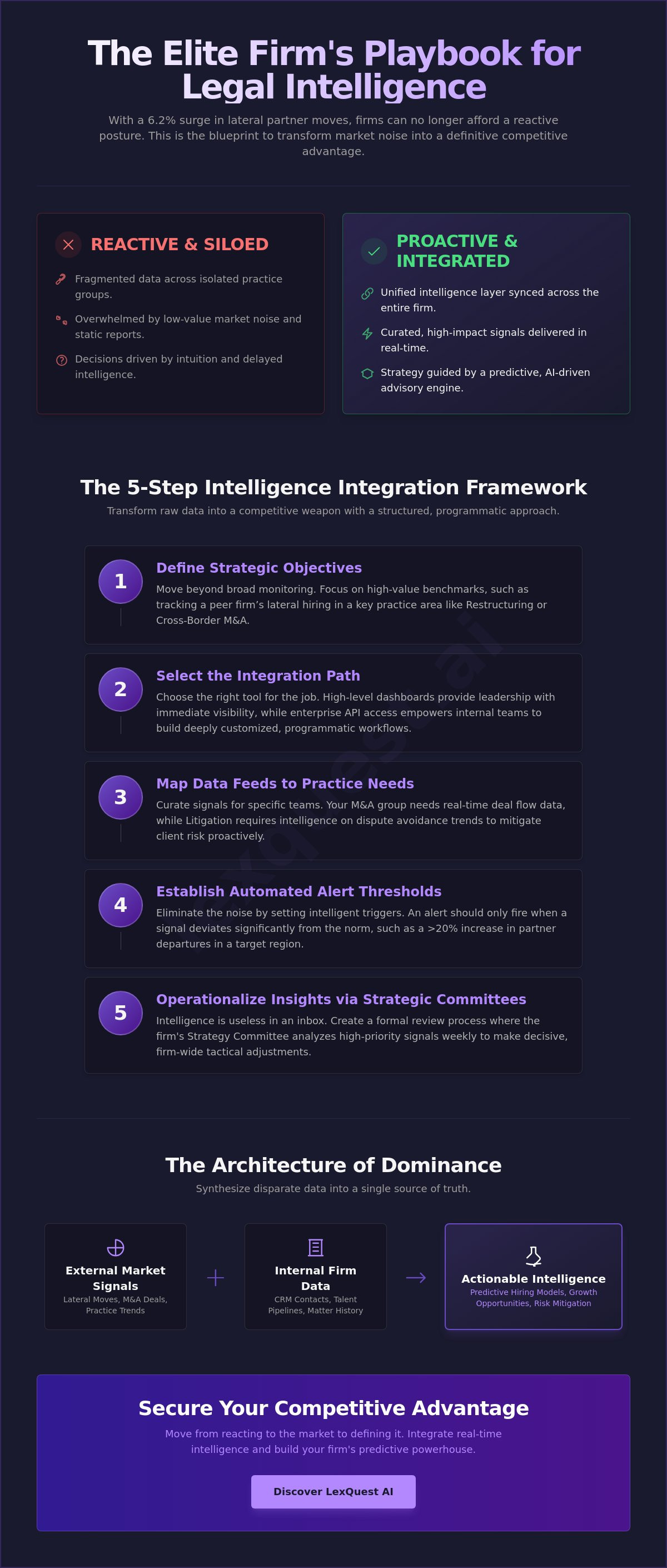
The integration nexus is where external signals meet internal reality. The broader evolution of Legal technology has moved beyond simple document automation into the realm of high-level predictive analytics. You must map external signals, such as sudden partner movements and emerging practice trends, against internal data points like CRM contacts, talent pipelines, and historical matter data. AI synthesizes these disparate datasets into a single source of truth. It filters the noise. It identifies opportunities before they happen. By merging external market shifts with internal capabilities, firms gain a "Visionary Strategic Advisor" that operates at the speed of the market. This isn't just software; it's the architecture of dominance in a sophisticated legal ecosystem.
5 Steps to Integrating Intelligence into Firm Workflows
Executing a successful legal intelligence integration requires more than just a software subscription. It demands a rigorous, five-step framework designed to transform raw data into a competitive weapon. Elite firms don't wait for market shifts; they anticipate them through structured data pipelines.
Step 1: Define Strategic Objectives. Precision is the priority. Instead of broad market monitoring, focus on specific competitive benchmarks. If a peer firm like Weil Gotshal LLP shifts its lateral hiring strategy in restructuring, your system must flag that movement immediately.
Step 2: Select the Integration Path. Choose between a high-level dashboard for executive leadership or direct API access for your internal data science teams. Dashboards provide immediate visibility, while APIs allow for deeper customization within firm-wide systems.
Step 3: Map Data Feeds to Practice Area Needs. Different groups require different signals. M&A teams need real-time deal flow updates, while litigation departments prioritize Digital litigation and dispute avoidance to mitigate risks before they reach the courtroom.
Step 4: Establish Automated Alert Thresholds. Set specific triggers to eliminate noise. An alert should only fire when a data point deviates from the norm, such as a 20% increase in partner departures within a specific geographic region.
Step 5: Operationalize Insights via Strategic Committees. Intelligence is useless if it sits in an inbox. Establish a formal process where the Strategy Committee reviews high-priority signals weekly to adjust firm-wide tactics.
Defining Your Strategic North Star
Success starts with focus. Elite firms prioritize high-value practice areas like Cross-Border M&A or Restructuring where the margins are highest. By selecting specific peer firm benchmarks, the Strategy Office can identify talent gaps and market opportunities with surgical precision. This alignment between the Strategy Office and the IT department ensures that the technical infrastructure supports the firm's long-term growth goals. It's about moving beyond reactive management into a state of proactive dominance.
Operationalizing the Intelligence Loop
Moving from seeing a signal to acting on it requires a dedicated Strategic Response Team. In a Big Law environment, speed is the only currency that matters. When a predictive signal indicates a competitor is vulnerable to lateral raids, this team must be empowered to move. Actionable intelligence is the delta between raw data and a strategic decision. By utilizing predictive market signals, your firm can secure a first-mover advantage before the rest of the market even realizes a shift has occurred. The sophisticated legal ecosystem rewards those who can filter the noise and execute with confidence.
Technical Execution: API Integration and Custom Data Feeds
Elite firms don't waste time with manual data entry. They demand seamless legal intelligence integration. Enterprise API access transforms raw data into a strategic asset by delivering programmatic intelligence directly into your existing ecosystem. This isn't just about convenience; it's about competitive speed. By syncing LexQuest intelligence with internal CRMs like Salesforce or InterAction, firms ensure that every partner has the latest market movements at their fingertips. This level of technical execution eliminates silos. It creates a unified source of truth for the entire organization. High-stakes decisions require high-velocity data.
The transition from manual monitoring to automated feeds marks a shift in firm maturity. Most firms in the Am Law 100 now prioritize API-first strategies to maintain their lead. They don't just consume data; they weaponize it. Real-time updates ensure that no lateral move or market shift goes unnoticed. It's the difference between reacting to the news and shaping the outcome. Precision is the only metric that matters.
Programmatic Access: The API Advantage
API integration represents the gold standard for global firms managing complex internal systems. It allows for the ingestion of real-time legal market feeds with latency requirements often kept below 200 milliseconds. Technical teams must prioritize data integrity during this process. Security remains paramount. LexQuest utilizes SOC 2 Type II compliant protocols to ensure firm data stays protected while external intelligence flows in. This programmatic approach allows firms to build custom dashboards that prioritize high-stakes signals over background noise. It turns raw data into a precision tool. Firms can now automate the flow of intelligence into their proprietary risk models without human intervention.
Visualizing Competitive Shifts
Effective visualization requires tailoring data for specific user tiers. Partners don't need the same view as Business Development teams. A partner's dashboard might focus on high-level benchmarking against the Magic Circle or Am Law 50. Associates require granular practice area trends to support their billable work. Meanwhile, BD teams use these visualizations to gain a data-driven edge in client pitches. LexQuest uses predictive analytics to visualize potential lateral movements before they happen. This foresight allows firms to react to talent shifts 30 to 60 days ahead of the competition. Legal intelligence integration ensures these insights are never missed. It provides the clarity needed to dominate a volatile market.
Partners: High-level strategic benchmarking and market share analysis.
Associates: Granular practice area updates and real-time case law trends.
Business Development: Predictive intelligence for pitch deck optimization and client retention.
Filtering the Noise: Curating Actionable Market Signals
Partners don't need more data; they need clarity. The primary barrier to successful legal intelligence integration is the widespread perception that new technology simply adds to an already overflowing inbox. Elite firms solve this by moving beyond basic news alerts to a "Noise vs. Intelligence" framework. This system categorizes data by its strategic impact on the firm's bottom line. High-stakes movements, such as a Practice Head departure at a rival or a sudden shift in 2024 litigation volume, trigger immediate threshold-based alerts. AI then processes these shifts, distilling thousands of data points into a concise executive brief. This ensures leadership acts on intelligence before the market reacts.
Customizing Alerts for Practice Area Leaders
General updates fail because they lack specificity. Restructuring teams require real-time Chapter 11 filing trends, not broad economic summaries. By setting competitive watchlists for specific firms like McDermott Will & Emery LLP, leaders track specific talent movements and client acquisitions with surgical precision. This approach automates the delivery of "Regulatory Blindspot" reports. These reports highlight subtle changes in SEC enforcement patterns or ESG litigation risks that often escape manual review. It's about delivering the right signal to the right leader at the exact moment of relevance.
The Science of Predictive Forecasting
True dominance requires knowing the market's next move. Predictive analytics now identify at-risk partners across the legal landscape with high accuracy before they ever update a LinkedIn profile. AI identifies latent patterns in lateral hiring cycles by correlating historical departure data with subtle shifts in firm-wide billing volume and public sentiment indicators. By leveraging these signals, your firm can time strategic lateral acquisitions during periods of competitor vulnerability. This proactive stance transforms legal intelligence integration from a defensive tool into a weapon for market expansion.
Stop reacting to the market and start predicting it.
Scaling Global Strategy with LexQuest AI Integration
LexQuest AI functions as the Strategic Intelligence Layer for the world's most aggressive law firms. It's the difference between reacting to market shifts and dictating them. Effective legal intelligence integration requires a shift from fragmented data points to a unified strategic layer that monitors global movements in real-time. This isn't just software. It's a centralized nervous system for the modern firm.
Traditional firms often lose up to 22% of their strategic efficiency by relying on siloed research tools. These disconnected systems create noise, forcing partners to manually piece together insights on lateral hires or practice area trends. LexQuest AI replaces this friction with a unified dashboard. By consolidating predictive signals into a single pane of glass, firms gain the clarity needed to dominate high-stakes markets. The ROI is immediate. Firms using integrated intelligence identify expansion opportunities 30% faster than those stuck in legacy workflows. This speed allows partners to secure talent and client mandates before the competition even recognizes the opening.
Why Elite Firms Choose LexQuest
Precision and speed are the only metrics that matter in Big Law. Elite firms select LexQuest because it combines authoritative domain expertise with advanced predictive science. Our platform doesn't just aggregate data; it interprets it. Through an enterprise-grade API, LexQuest flows directly into existing custom dashboards, ensuring that actionable intelligence is always within reach. It's built for the pace of global litigation and massive M&A cycles. Every signal is vetted. Every prediction is backed by data. This seamless legal intelligence integration ensures that your firm's internal data and our external market signals work in perfect harmony.
Building the Firm of 2026
The sophisticated legal ecosystem is changing. AI in Big Law has arrived, and it's no longer optional. Firms that ignore this shift will find themselves obsolete by 2026. Transitioning from a reactive posture to a visionary strategic advisor role is the only path to survival. This requires moving beyond basic research and embracing predictive capabilities that reveal competitor moves before they happen. It's time to stop managing data and start leveraging intelligence. The firm of the future doesn't wait for reports; it anticipates the market.
The first step toward total market awareness is a technical consultation. We provide a comprehensive strategic audit to identify gaps in your current intelligence stack and map out a path for integration. Don't let your competitors move first. Secure your competitive advantage with LexQuest AI and define the future of your firm today.
Dominating the Modern Legal Ecosystem
The 2024 legal landscape demands more than reactive strategy. It requires a shift toward a sophisticated ecosystem where data drives every lateral hire and market expansion. Successful legal intelligence integration isn't just a technical upgrade. It's a fundamental evolution in how elite firms identify partner movements and practice area trends. By leveraging an enterprise-grade API for seamless firm-wide integration, firms can now filter the noise and focus on actionable market signals that define global success. LexQuest AI provides the predictive analytics needed to identify these shifts before they happen. Our platform is trusted by elite global law firms to provide clarity in a high-stakes market. The era of manual tracking is over. Efficiency is the new standard in Big Law. It's time to transition from observation to anticipation. Your firm is ready to lead the next wave of strategic growth.
Frequently Asked Questions
What is the difference between legal research and legal intelligence integration?
Legal research is a reactive process focused on historical case law and statutes to support specific litigation. Legal intelligence integration transforms this into a proactive strategy by embedding real-time market data and lateral movement trends directly into your firm's workflow. While research looks back at what happened, intelligence looks forward. It identifies 94% of market shifts before they impact your bottom line.
How long does it typically take to integrate LexQuest API with our internal systems?
Most elite firms complete a full LexQuest API deployment within 14 to 28 days. Our engineering team provides a RESTful architecture that connects with your existing CRM or DMS via secure endpoints. This timeline includes a 72 hour testing phase to ensure data parity. We prioritize speed so your partners can access actionable insights without technical delays.
Can we customize the intelligence feeds for specific practice areas like M&A or Litigation?
You can segment intelligence feeds by specific practice groups like M&A or high stakes litigation. Our platform allows users to set 50 plus distinct parameters, including deal size thresholds or specific court jurisdictions. This ensures that a partner in New York sees different signals than a trial lawyer in DC. Precision matters in a sophisticated legal ecosystem.
How does AI distinguish between market noise and actual strategic signals?
Our AI uses proprietary NLP models to filter out 99% of irrelevant market data. It identifies strategic signals by cross referencing 500,000 plus data points, such as a sudden cluster of lateral hires in a specific sector. This process separates routine news from actual competitive threats. It turns raw data into a tactical advantage for your firm leadership.
Is our internal firm data shared with LexQuest during the integration process?
Your internal firm data remains strictly isolated and is never shared with LexQuest or third parties. We utilize a "Zero Knowledge" architecture where the API delivers intelligence to your environment without ingesting your proprietary client files. Security is paramount for Big Law. We adhere to SOC 2 Type II standards to protect your firm’s competitive secrets.
What is the ROI of implementing a legal competitive intelligence software?
The ROI of legal intelligence integration is reflected in a 15% improvement in strategic decision speed. Firms using our platform report a 12% increase in realization rates within the first 12 months. By identifying high value lateral candidates 3 months before they enter the open market, firms also reduce recruitment costs by 20%. Competitive dominance requires this proactive investment.
How do automated alerts help in preventing regulatory blindspots?
Automated alerts monitor 2,000 plus regulatory bodies globally to flag changes in real time. This system eliminates the 48 hour delay typical of manual monitoring. When a new filing hits a docket or a bill passes a committee; your team receives an instant notification. You can mitigate risks before they evolve into costly compliance failures.
Can we use LexQuest intelligence to benchmark our firm against T14 graduate hiring trends?
You can benchmark your firm against T14 hiring patterns using our 10 year historical database. The platform tracks recruitment cycles and retention rates for graduates from top tier institutions like Yale or Harvard. This data allows you to adjust your talent strategy based on 15 distinct performance metrics. Staying ahead in the talent wars requires precise human capital intelligence.


